There are only two ways to make R&D go faster. You can do the work faster. Or you can avoid doing work you've already done.
Most innovation strategies focus almost entirely on the first lever — better instruments, more automation, bigger teams, faster screening. Far fewer focus on the second, even though it's often the cheaper and faster win: the answer to your current question may already be sitting in reports from three years ago, written by someone who has since moved teams, moved companies, or simply forgotten they ever ran that experiment.
That's the case for historical data. And most R&D organizations, if they're honest, are sitting on more of it than they're using.
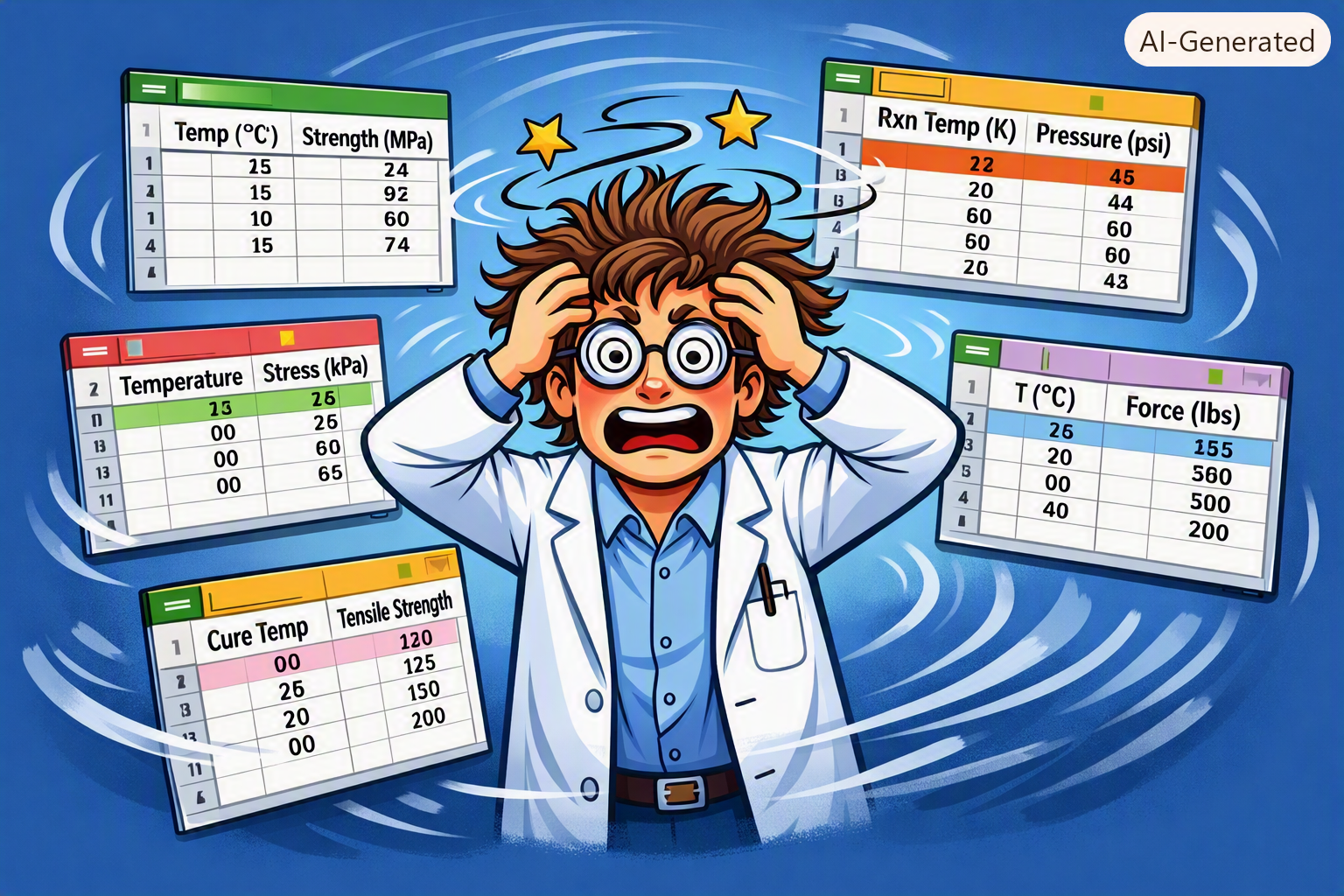
The Data You Already Have
Ask most lab leaders whether their historical experimental data is digitized, and the answer is usually yes. Electronic lab notebooks (ELNs), shared drives, scanned notebooks, batch records — the raw material exists, often going back decades. Ask them whether that data is actually usable — searchable across experiments, comparable across years, combinable into something bigger than any single study — and the answer is usually no.
This gap has a name. It's the difference between data that is merely digitized and lab data that is truly FAIR: Findable, Accessible, Interoperable, and Reusable.
Most organizations have solved Findable and Accessible. If you know roughly what you're looking for, you can probably locate the file and open it. What's almost always missing is Interoperable and Reusable — the ability to take data from one experiment and combine it, directly and automatically, with data from another. That's a much higher bar, and it's the one that actually determines whether historical R&D data can significantly accelerate anything. R&D organizations' ability to make ML models and use AI for accelerating innovation entirely depends on it.
What Does "Structured" Lab Data Actually Mean? A Real Example
This distinction can sound abstract, so it helps to see two actual lab notebook entries side by side — the kind of entries that exist, in some form, in almost every R&D archive. Let us look at this with concrete toy examples.
Experiment A — logged in 2021
Title: Effect of Cure Temperature on Adhesive Bond Strength
Experiment ID: EXP-2021-0447
Author: J. Alvarez
Objective: Evaluate how cure temperature affects final bond strength of Formulation 3B.
| Temp (°C) | Strength (MPa) | Batch ID |
|---|---|---|
| 20 | 24.1 | B-101 |
| 30 | 29.8 | B-102 |
| 40 | 34.5 | B-103 |
| 50 | 38.9 | B-104 |
| 60 | 41.7 | B-105 |
Experiment B — logged in 2023, by a different scientist
Title: Tensile Strength vs. Reaction Temperature — Formulation V2
Experiment ID: EXP-2023-0118
Author: R. Okafor
Objective: Characterize tensile strength response of Formulation V2 at elevated reaction temperatures.
| Reaction Temperature | Tensile Strength (MPa) | Sample |
|---|---|---|
| 50 | 40.2 | S-01 |
| 60 | 37.4 | S-02 |
| 70 | 30.1 | S-03 |
| 80 | 22.6 | S-04 |
| 90 | 15.3 | S-05 |
Read separately, these look like two different stories
Experiment A says higher temperature is better. Experiment B says higher temperature is worse. A scientist encountering only one of these would draw a confident, defensible, and incomplete conclusion.
Now look at what each level of "searchable" would actually give someone trying to reconcile the two:
- • Metadata search (typical in a modern ELN) finds both records by title or keyword — "temperature," "strength." You still have to open both, read the tables, and reconcile them yourself.
- • Full-text search (typical in a decade-old, digitized-but-unstructured archive) finds the word "temperature" or "strength" wherever it appears. It still can't tell you that Temp (°C) and Reaction Temperature are the same variable, or that Strength (MPa) and Tensile Strength (MPa) are the same measurement.
- • Structured data means both tables are re-expressed against one shared schema — same field names, same units, same variable definitions — so a computer, not a person, can merge them.
What structuring reveals
Once both tables are mapped onto the same schema — Temperature_C, Strength_MPa, Source_Experiment — they combine into a single dataset:
| Temperature_C | Strength_MPa | Source |
|---|---|---|
| 20 | 24.1 | EXP-2021-0447 |
| 30 | 29.8 | EXP-2021-0447 |
| 40 | 34.5 | EXP-2021-0447 |
| 50 | 38.9 | EXP-2021-0447 |
| 50 | 40.2 | EXP-2023-0118 |
| 60 | 41.7 | EXP-2021-0447 |
| 60 | 37.4 | EXP-2023-0118 |
| 70 | 30.1 | EXP-2023-0118 |
| 80 | 22.6 | EXP-2023-0118 |
| 90 | 15.3 | EXP-2023-0118 |
Plotted together, Experiments A and B don't contradict each other — they trace a single continuous curve. Strength rises with temperature up to roughly 55–60°C, then falls. Neither experiment on its own shows this; each one only captured a slice of a curve with an optimum in the middle. The insight was always there, split across two documents, two years, and two slightly different vocabularies. It wasn't accessible until the data was structured the same way in both places.
This is a simplified, illustrative example. Real experimental data is messier — more variables, more inconsistent table layouts, more unit systems, more scientist-specific shorthand. For example, to be able to combine these two tables, you need to be sure these measurements have been made on the same formulations. But the hurdle is exactly the one shown above, multiplied across thousands of experiments: different table structures, slightly different terminology, different units, different levels of completeness. That inconsistency, not a lack of data, is what keeps historical R&D data from being reusable.
Structuring Doesn't Replace The Need For Good Documentation
It's worth being precise about what structuring does and doesn't do. It doesn't reduce how much scientists need to record, and it isn't a reason to document more sparsely on the assumption that "the system will sort it out." A poorly documented experiment, one missing a batch ID or a key observation, is just as much of a dead end after structuring as before it.
What structuring changes is what happens after the documentation exists. Today, most of the burden of making an experiment reusable falls on the scientist at the moment of writing it up: getting the terminology consistent, filling in the right fields, anticipating how someone might search for it years later. Structuring moves that burden downstream. Scientists can keep writing the way they actually write, in full detail, in whatever format suits the work, and the job of turning that record into comparable, searchable knowledge happens afterward, automatically. The goal isn't to need less documentation. It's to stop losing the value of the documentation you already require.
Why Lab Data Stays Locked
If the value of joining data like this is so obvious, why hasn't it already been done? Two reasons, mostly.
The first is technical: lab software changes. A notebook system from a decade ago may no longer be supported, or may export data in a format nobody uses anymore. The data survives, but it's stranded. Or maybe the organization never had an ELN in the first place, and the data is in folders or SharePoint repositories.
The second is human, and arguably more important: rigid structured-entry systems ask scientists to fit their daily work into someone else's schema at the moment of doing the science — choosing fields, filling dropdowns, tagging variables — while they're focused on the experiment itself. Most scientists, reasonably, resist this. It slows them down and rarely accounts for the exact variable they happen to be studying that week. So structured entry gets adopted in principle and abandoned in practice, and labs default back to free-text write-ups like Experiments A and B above, because that's what actually matches how research gets done.
For years, the only fix was manual cleanup — someone going back through old records, experiment by experiment, standardizing terminology and re-entering data into consistent tables. It's exactly the kind of work that's valuable in aggregate and unbearable in practice. Almost nobody has the headcount to do it at the scale that matters, so it mostly doesn't get done, and the historical archive stays exactly as inconsistent as the day it was written. This leads to redundant experimentation to re-invent the wheel.
How AI Now Makes Historical Lab Data Reusable
This is the part that's new: large language models can now read messy, inconsistent, real-world lab documents — write-ups, batch records, mixed-format tables — and do the standardization after the fact, without requiring scientists to change how they work going forward. Using the context available in the experimental write-up, the model reads "Reaction Temperature" and "Temp (°C)" and recognizes them as the same variable. It separates values from units. It maps one lab's shorthand onto another's. What used to require a dedicated data-cleaning team working for months can now happen automatically, on records going back as far as your archive does.
This is what we've built Augmend to do: take the historical experimental data your organization already has — however inconsistently it was recorded — and turn it into a single, structured, comparable resource. Not by changing how your scientists work tomorrow, but by finally making sense of everything they've already written.
The Real Cost of Leaving Data Locked
Experiments A and B weren't wasted. The work was done, the data was real, the observations were correct. What was missing wasn't effort — it was the ability to bring the two together. Multiply that across a decade of experiments, dozens of scientists, and thousands of documents, and the hidden insights sitting unused in most R&D archives are almost certainly larger than most organizations realize.
Unlocking that isn't a data-hygiene project to get to eventually. It's a direct, available lever on how fast your R&D moves — arguably a faster one than anything you could buy in new lab equipment.
Ready to unlock your historical R&D data? We'd like to talk.
Schedule a CallFrequently Asked Questions
What is structured lab data?
Structured lab data is experimental data recorded using consistent fields, units, and terminology across experiments, so records from different scientists, projects, or years can be directly compared or combined. It's distinct from digitized data, which is simply stored electronically but may still use inconsistent formats, table layouts, and vocabulary.
What are the FAIR data principles?
FAIR stands for Findable, Accessible, Interoperable, and Reusable. Most organizations achieve the first two — data can be located and opened — but fall short on Interoperable and Reusable, meaning data from different experiments can't be automatically combined or reused without manual rework.
Why can't I just search my electronic lab notebook (ELN) for this?
Metadata and full-text search can locate documents that mention a topic, but they can't recognize that two differently named fields — like "Temp (°C)" and "Reaction Temperature" — represent the same variable. That mapping is what structuring provides, and it's what makes cross-experiment analysis possible.
Why is historical R&D data hard to reuse?
Two main reasons: legacy software formats that strand old data, and the fact that rigid structured-entry systems slow scientists down during actual experiments, so most labs default to free-text write-ups that are hard to compare later.
How does AI help structure legacy lab data?
Large language models can read inconsistent, free-text experimental records — regardless of table layout or terminology — and map them onto a shared schema after the fact. This makes it possible to structure years of historical data without requiring scientists to change how they record experiments going forward.